
What is Engineered Marketing?
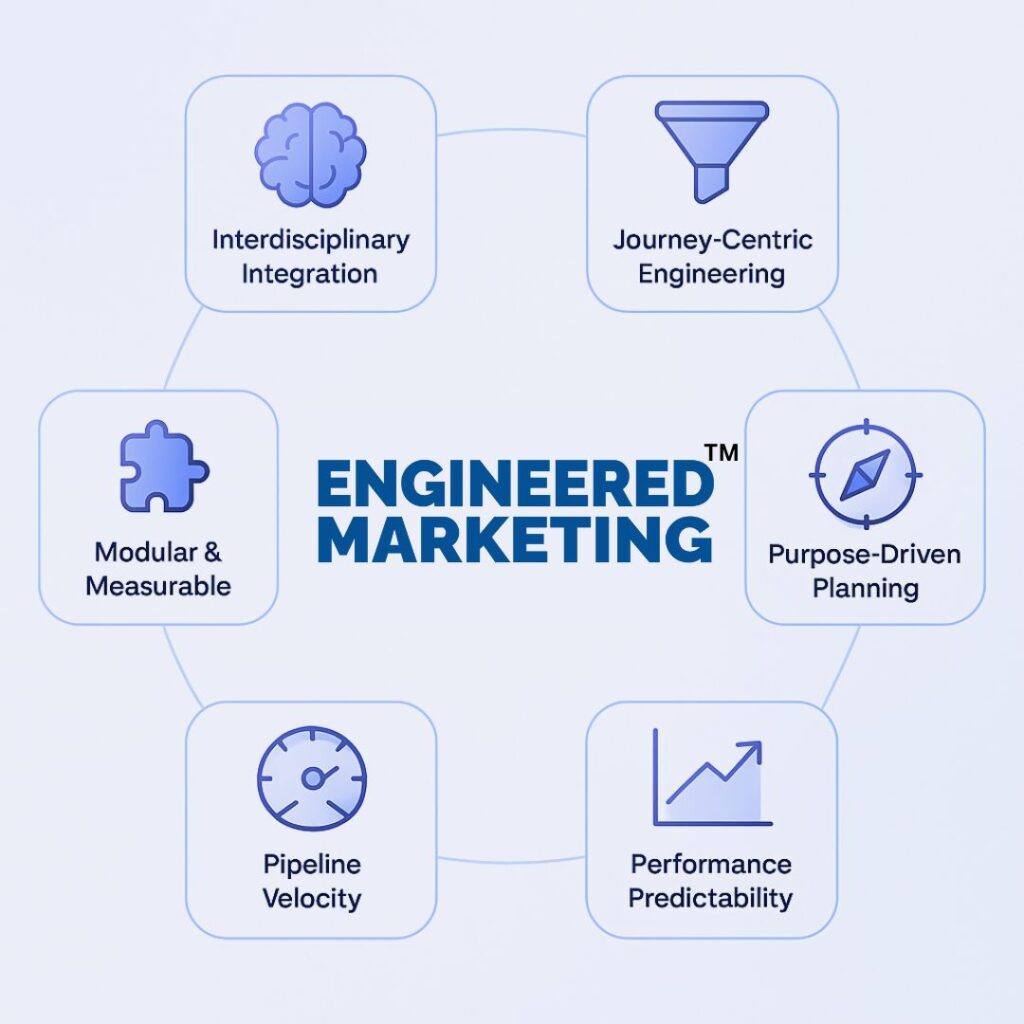
Abrar Syed Areef defines it as follows: Engineered marketing is a structured approach that integrates marketing psychology, strategy, data science, artificial intelligence and machine learning, ensuring the seamless orchestration of marketing channels, methods and touchpoints with precision, and an inherent capacity to evolve with future technologies, concepts, and market shifts for maximum impact.
Overview
In a world of evolving and somewhat evolved artificial intelligence, emotional intelligence is declining. You may ask, what’s the correlation? We’re outsourcing logic to machines but unintentionally dulling our ability to empathize, listen, and be present.
So the question arises: is it even required? True progress lies not in choosing one over the other, but in evolving both, so that as machines get smarter, we don’t forget how to stay human.
Now you may wonder, what does it have to do with marketing?
In simple terms marketing is the process of communicating the value of a product or service to a target audience so they become paying customers.
But technically there is more to it. Marketing has evolved over time based on factors like need, resources and most importantly demand and supply. To name a few, here are traditional marketing, digital marketing and performance marketing. With the emergence of every new possibility even the greatest processes were left behind merely because every business was doing it.
In recent days businesses don’t carry out or even consider traditional marketing, why? Because others aren’t doing it either. But don’t you think traditional marketing has worked for many businesses over the years? What works for one business might not work for another, and simply copying what your competitors are doing isn’t real marketing.
It is simply stupidity in action. Every business carries a distinct story, USP, value proposition, and model of working, and the same applies to its audience. Every business has an audience of its own.
So identifying what will work and creating a mixed marketing model accordingly becomes essential. Here is the functional and operational concept of ‘Engineered Marketing,’ evolved by considering every factor that was once overlooked.
Why Does Marketing Need Engineering Principles?
Marketing today is no longer just about creativity or communication. It’s about precision, structure, and adaptability. In a fragmented digital landscape where consumer attention is fleeting and data is overwhelming, traditional marketing mindsets fall short. That’s where engineering principles step in.
Engineering is about building systems: systems that are efficient, scalable, and designed to solve problems. When these principles are applied to marketing, we no longer treat campaigns as isolated events, but as parts of an interconnected whole. This means:
- Designing marketing like architecture: with strategy, structure, and scalability in mind
- Eliminating guesswork, through data science, AI, and a feeder mechanism
- Orchestrating channels, touchpoints, and methods, in a way that each complements the other
- Accounting for adaptability, so that the system evolves with technology and human behavior
The Engineered Marketing Framework
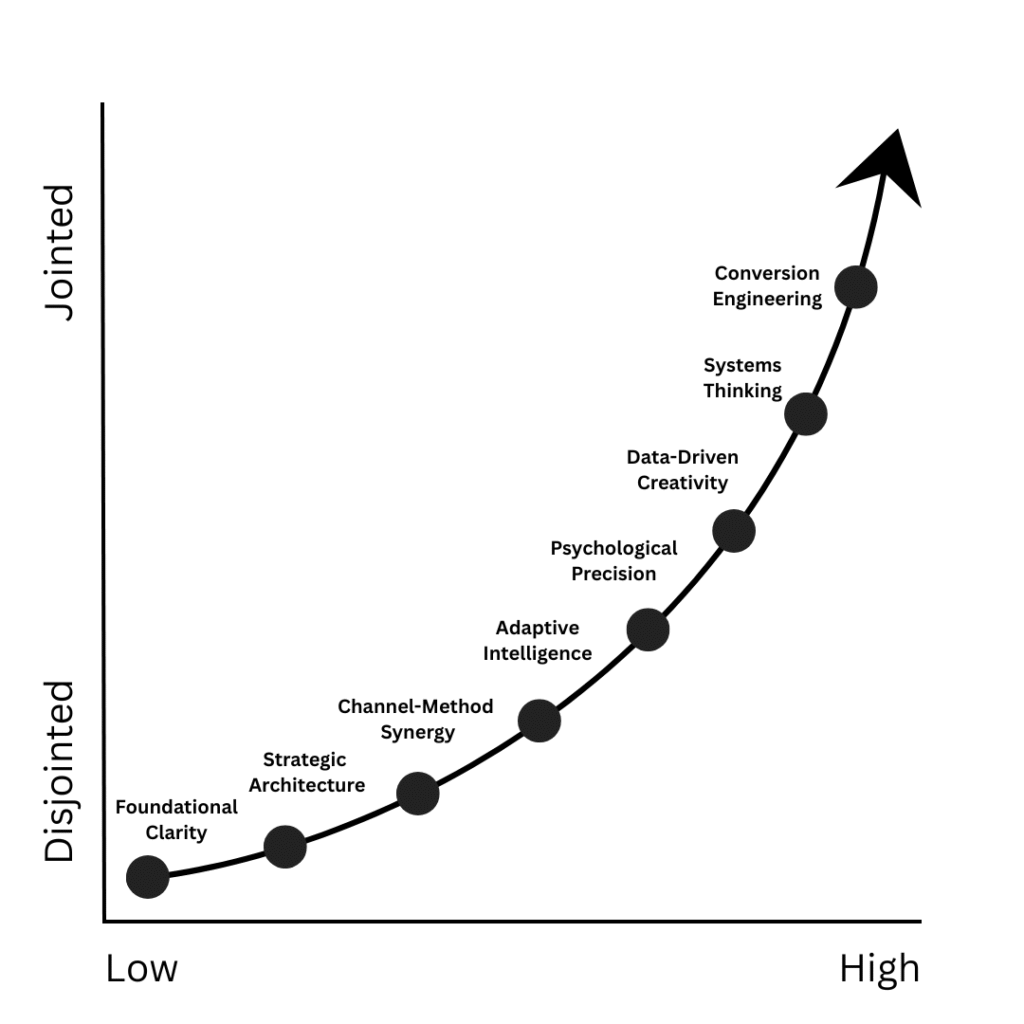
The philosophy behind Engineered Marketing isn’t just theoretical, it’s built on a practical, evolving framework. As illustrated below in the Engineered Marketing Progression Curve, this approach begins with Foundational Clarity and matures through stages like Strategic Architecture, Channel-Method Synergy, and Systems Thinking, culminating in Conversion Engineering.
This journey reflects how marketing must evolve: from being disjointed and scattered to being intelligent, data-driven, creative and most importantly, joined in purpose and performance.
Marketing needs engineering because it’s no longer about doing more. It’s about doing what works: systematically, intelligently, and sustainably. This approach doesn’t discard creativity; instead, it elevates it by giving it structure — a system within which creativity, psychology, and technology work together.
Just like architecture turns bricks into buildings, Engineered Marketing turns scattered marketing efforts into high-impact, interconnected growth systems.
Core Elements of Engineered Marketing
Engineered Marketing, as envisioned by Abrar Syed Areef, operates at the intersection of science, strategy, and psychology. Its strength lies not in isolated tactics, but in how each element works as part of a structured, intelligent system.
These five core elements form the backbone of the Engineered Marketing approach:
1. Psychology
Understanding the human mind is at the heart of effective marketing. This element focuses on decoding consumer behavior, emotional triggers, cognitive biases, and decision-making patterns — ensuring every campaign resonates at a deeper, more personal level.
2. Strategy
Structure replaces spontaneity. Engineered Marketing employs goal-driven planning rooted in business objectives, competitive context, and long-term vision. It’s about designing a clear path from intent to impact.
3. Data & Analytics
Data informs decisions, not assumptions. This pillar ensures every move is backed by insight: through performance tracking, user behavior analysis, and iterative feedback loops, marketing becomes both agile and accountable.
4. AI & Machine Learning
Modern marketing demands modern tools. AI and ML bring scalability, personalization, and predictive power to the mix; enabling smarter segmentation, real-time optimization, and automation that goes beyond surface-level.
5. Channel Orchestration
Customers don’t experience marketing in silos, and neither should strategy. Channel Orchestration ensures every touchpoint, platform, and message works cohesively: it’s the art of creating a seamless, consistent brand experience across the entire journey.
6. Adaptability & Evolution
Engineered Marketing isn’t static. It’s built with adaptability at its core: designed to evolve with emerging technologies, shifting consumer behavior, and market dynamics. Whether through feeder systems, automation, or innovation-first thinking, it ensures marketing systems remain resilient and future-ready.
Visualizing Engineered Marketing Maturity
Most organizations begin with scattered marketing efforts—ad‑hoc campaigns, disconnected channels, and unpredictable outcomes. That’s what the first graph reflects: results that jump up and down with no structure or coordination. The second graph shows what happens when you apply a structured, integrated system: growth becomes consistent, measurable, and scalable.
Before: Growth Without Engineered Marketing
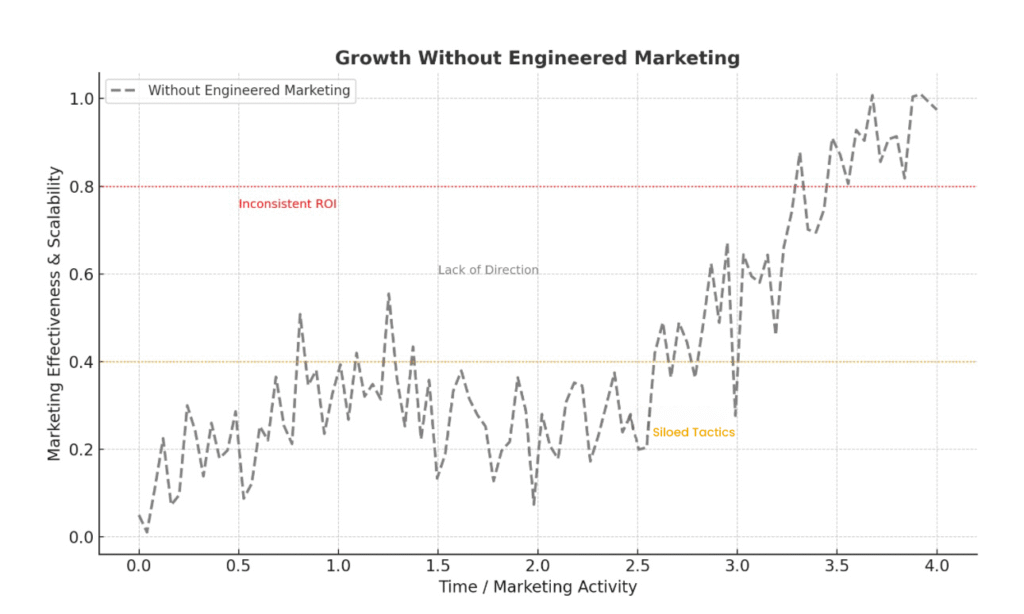
Here is the curve illustrating growth without Engineered Marketing – marked by inconsistency, inefficiency, and lack of scalability. The chaotic pattern represents disjointed efforts, siloed tactics, and unstable outcomes that typically arise when marketing isn’t structured or integrated.
After: Abrar’s E.M. Curve — Engineered Marketing Maturity
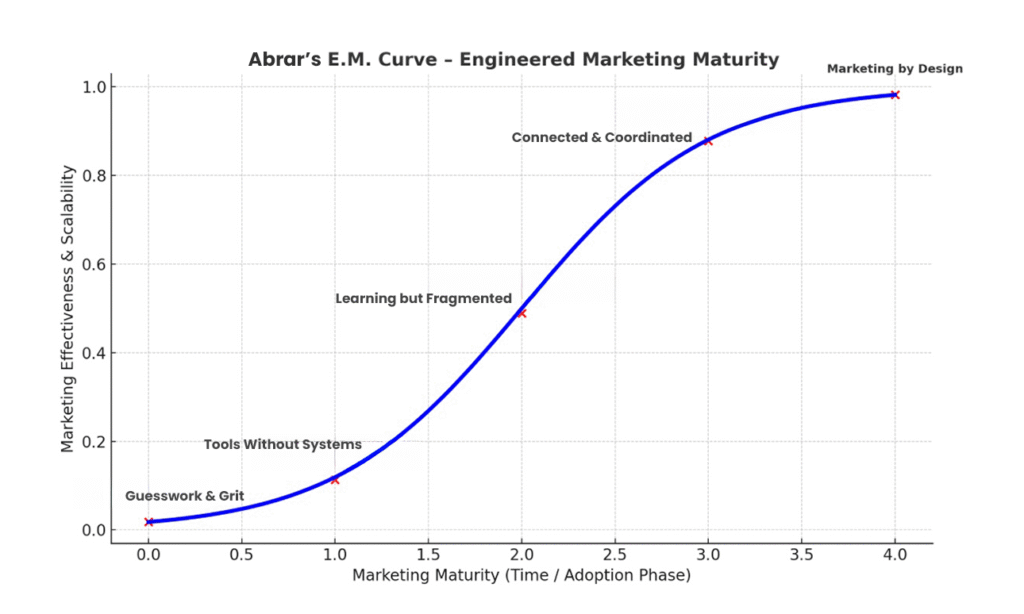
Here is the Abrar’s E.M. Curve — a visual model showing how marketing evolves from intuition to a fully engineered, scalable system. Each stage represents a milestone toward structured, high-performance marketing.
Interpretation:
* In the Engineered Marketing Curve, as marketing maturity increases, the structure and coordination improve, leading to steadily higher effectiveness and scalability.
* In the Non-Engineered Marketing Curve, despite ongoing activity over time, the lack of systems causes plateaus, regressions, and inefficiencies.
Who Can Use Engineered Marketing?
One of the most powerful truths behind Engineered Marketing is that it doesn’t discriminate by business type or size. Built on engineering principles of precision, data, and structure, it’s designed to work across sectors, industry models, and stages. From solopreneurs to enterprise teams, Engineered Marketing helps build tailored systems that scale.
Ideal Users & Beneficiaries
Small Business Owners & Local Services
Local retailers, service providers, consultants, coaches and contractors often face erratic leads and inconsistent cash flow. Engineered Marketing offers them systems to stabilize lead generation and conversion, akin to building a reliable, high‑performing sales pipeline rooted in process design and measurable feeder systems.
Professional Services & B2B Firms
When marketing isn’t just about visibility but about convincing precise stakeholder personas, Engineered Marketing delivers. It integrates behavioral psychology and strategy to map customer journeys, craft high‑impact messaging and build scalable funnels that convert.
E‑commerce & Online Businesses
From product launches to automated re‑engagement campaigns, Engineered Marketing helps online brands automate and personalize at scale. AI‑driven tools alongside data analytics allow businesses to deliver tailored messaging across channels intelligently.
Agencies & Consulting Firms
Agencies can deliver better ROI by treating each client’s marketing stack like a production system, identifying bottlenecks, optimizing flows and iterating with data‑informed feedback. It’s precision marketing through aligned process.
Tech Startups & SaaS Companies
Tech first ventures can leverage Engineered Marketing to build “engineering as marketing” tools, for example calculators, interactive widgets and microsites, that not only solve real user problems but generate leads and showcase product value.
Healthcare & Health Sciences Organizations
Healthcare providers, clinics, hospitals, telehealth platforms, life sciences firms and wellness brands can use Engineered Marketing to personalize patient journeys, automate outreach, orchestrate compliant multi‑channel communication and improve ROI through data‑driven performance systems.
Conclusion
Engineered Marketing isn’t just another catchy philosophy; it’s a structured, measurable, and adaptable growth system that works for every type of organization, whether you’re a solopreneur, a wellness startup, or an enterprise team. It integrates psychology, strategy, data, AI, and channel orchestration into a unified framework that scales with your unique business needs.
Why should you care? Because with marketing noise and fragmented channels evolving faster than ever, guesswork doesn’t work; it’s precision, pipeline, and plasticity that win. Engineered Marketing cuts through the chaos and turns marketing into a high‑impact system that grows smarter over time.